



🌫️ Kuching’s ESG Smart Poles: What Do the Air Quality Readings Really Mean?
🌫️ Kuching’s ESG Smart Poles: What Do the Air Quality Readings Really Mean?
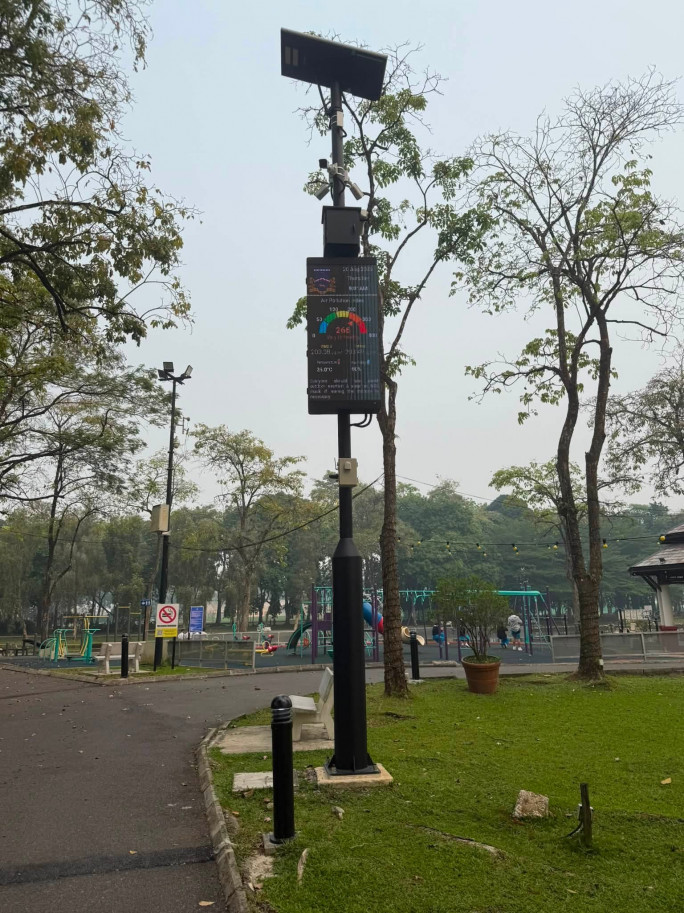
With the haze situation affecting parts of Sarawak, many Kuching residents have been keeping a close eye on air quality readings. But did you know that the ESG Smart Poles at MBKS Park only monitor air quality within a limited area? 🌫️📍According to UKM senior lecturer Assoc Prof Dr Mohd Shahrul Mohd Nadzir, the sensors can analyse air pollutants within a radius of around 2–3km.
That means the two smart poles at MBKS Park cannot represent the air quality of the entire Kuching area. To obtain a citywide picture, more sensors would need to be installed across different parts of Kuching.
🔎 What do the sensors measure?
The Air Pollutant Index (API) is calculated based on five major pollutants:
• Carbon monoxide (CO)
• Nitrogen dioxide (NO₂)
• Sulphur dioxide (SO₂)
• Ozone (O₃)
• Particulate matter (PM)
Kuching South Mayor Dato Wee Hong Seng also clarified that the ESG Smart Poles are designed mainly for localised, real-time monitoring, particularly for people using MBKS Park for exercise and outdoor activities.
Importantly, the smart pole readings are not the official API readings issued by the Natural Resources and Environment Board (NREB) or Department of Environment (DoE).
👉 In simple terms:
ESG Smart Pole = localised, real-time and indicative reading
NREB/DoE = official API reading
Air quality can also vary from one location to another, so a reading taken at MBKS Park may not reflect conditions in other parts of Kuching.
MBKS is also looking at relocating one of the existing poles to another public park and exploring the possibility of installing more ESG Smart Poles in the future.
As Mayor Wee emphasised, public health comes first. The smart poles are meant to complement—not replace—the official API monitoring system. 💨🏙️
📷Aaron Ting Seng Wee

Related Posts





Latest Posts



Comments (0)
Be the first to write a comment for this article.Write a comment